
The European pharmaceutical industry continues to grow in terms of production and investment, but is losing ground in the global competition for innovation. This is a scenario that also has significant implications for marketing and communication. Communicating innovation means giving science a voice and a clear form, while keeping at the centre both the people it is intended for and those who contribute to making it possible every day.

The figures describe an extremely solid sector. According to EFPIA’s The Pharmaceutical Industry in Figures – Key Data 2026, in 2024 the value of European pharmaceutical production reached €463.9 billion, while investment in research and development reached €56.3 billion, with a forecast of €60 billion in 2025. Employment figures also confirm pharma’s role as one of the strategic sectors of the European economy, with almost 951,000 direct employees and an estimated indirect impact approximately three times greater. Productivity tells the same story. With around €225,000 in gross value added per worker, the sector records levels approximately three times higher than the average across the European economy.
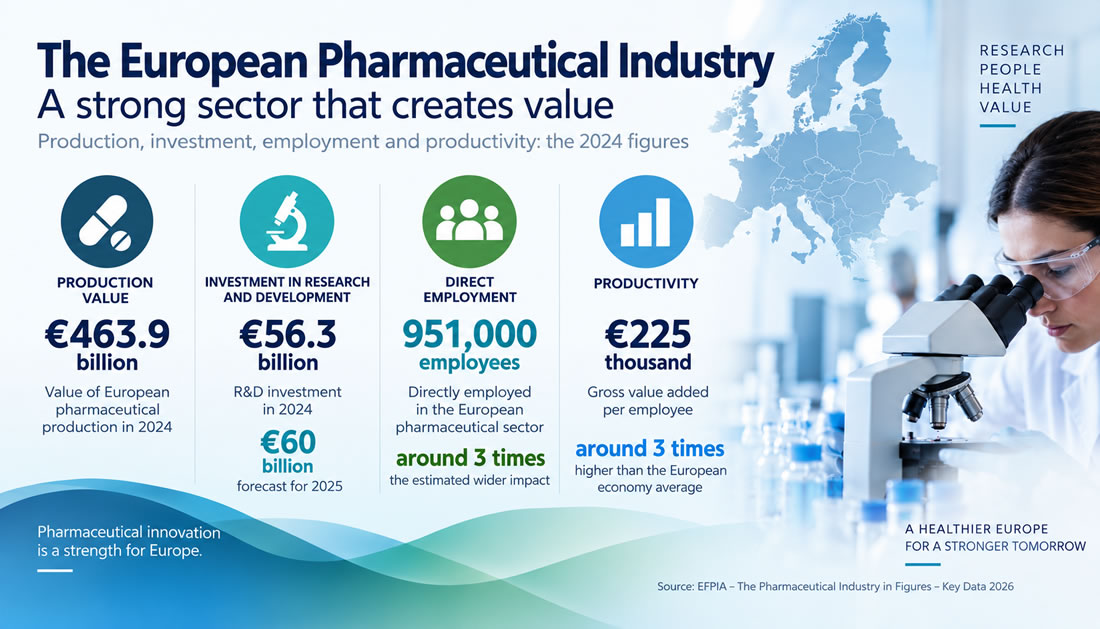
The European pharmaceutical industry in figures: production, investment in research and development, employment and productivity confirm the sector’s strategic importance to the European economy. Source: EFPIA, The Pharmaceutical Industry in Figures – Key Data 2026
Behind these figures, however, there is a phenomenon that deserves particular attention. Europe continues to produce and invest, but the centre of gravity of global pharmaceutical innovation is gradually shifting. In 2025, of the 104 new active substances launched worldwide, 46 originated from companies headquartered in China, 28 in the United States and only 16 in Europe. Even more significant is the data relating to the market for new therapies. Between 2020 and 2024, 74.1% of global sales of new medicines were generated in the United States, while the five leading European markets accounted for a combined 15.6%. The issue, therefore, concerns Europe’s ability to remain one of the places where innovation is developed, funded, tested and brought to patients, as well as its ability to generate economic value.
In a market where competition is increasingly driven by the ability to innovate, communication is also called upon to make this innovation visible, understandable and relevant, while keeping its human dimension at the centre. For pharmaceutical companies, this means highlighting both products and the wider ecosystem that makes innovation possible, comprising research, expertise, scientific partnerships, healthcare professionals and, above all, patients, with their needs, experiences and the tangible value that innovation can bring to care pathways.
This is where marketing and communication take on an increasingly strategic role. The objective includes simplifying complex scientific content and building a narrative capable of connecting research to its practical meaning and adapting it to stakeholders with different needs. The same innovation can, in fact, have different meanings. For a clinician, it may represent a therapeutic advance; for a patient, a new treatment option; for the healthcare system, a potential improvement in care pathways; and for a researcher, the opening of new scientific perspectives. Within this ecosystem, the patient is assuming an increasingly central role. They are the ultimate recipient of innovation and, at the same time, a stakeholder whose perspective contributes to defining needs, priorities and the value of care pathways.
The picture provided by EFPIA therefore reinforces an evolution already under way in the way pharmaceutical companies build their communications. If competition is increasingly shifting towards research and innovation, it becomes even more important to build, over time, the context in which that innovation will be understood and recognised. This means explaining why a particular therapeutic area still requires research, which patient needs remain unmet, how science and technology are evolving, which expertise is required, and what role is played by companies, universities, research centres, healthcare professionals and patient associations.
In a scenario where research, investment and talent are increasingly contested, a company’s reputation as an innovator depends both on what it develops and on its ability to communicate the value of its research and the contribution it can make to patients, professionals and healthcare systems.
Building this multidimensional narrative requires more than simply adapting content. It requires dedicated environments where dialogue between stakeholders can take place in a structured, secure and meaningful way. The digital transformation of the healthcare sector provides an opportunity to move from one-way communication towards active engagement (stakeholder engagement), enabling stakeholders to co-create value.
Platforms such as Digital Health Room are designed to address this specific need. In a context where innovation needs to be communicated effectively in order to be understood, these digital spaces become the natural setting for bringing together scientific expertise, patient needs and strategic vision. They are genuine laboratories where expertise in healthcare communication combines with digital innovation to generate concrete solutions.
Through digital consensus tools, patient-centricity pathways and treatment & knowledge analysis, it is possible to turn complex data into stories that are relevant to each audience. In this way, technology becomes an essential enabler of the strategic objective highlighted by the EFPIA data: turning science into recognised value.
Innovation remains a matter of science, and the ability to turn it into shared value depends on how it is communicated.
Pharmaceutical innovation communication makes scientific research, new therapeutic solutions and their tangible value understandable to healthcare professionals, patients, institutions and other stakeholders.
Clear communication makes it possible to understand the value of research and the potential impact of innovation on care pathways. It also contributes to the reputation of pharmaceutical companies and to dialogue with stakeholders.
Healthcare communication translates complex scientific and clinical information into clear, accurate and relevant content for different audiences, supporting the responsible dissemination of knowledge across the health sector.
It is the structured involvement of healthcare professionals, researchers, institutions, associations and other stakeholders. It makes it possible to gather different perspectives and develop a shared understanding of innovation.
Digital tools make it possible to share scientific content, create environments for discussion and engage different audiences, transforming one-way communication into an ongoing dialogue between pharmaceutical companies and stakeholders.
Would you like to share a project with us, explore a potential collaboration, or find out more about Digital Health Room’s activities? Complete the form and we will be pleased to connect with you and explore new opportunities for collaboration and innovation in healthcare.
A laboratory where digital innovation and strategic communication meet to develop concrete solutions for the healthcare sector.

Copyright 2026 Digital Health Room presented by Heritage & Syroop
